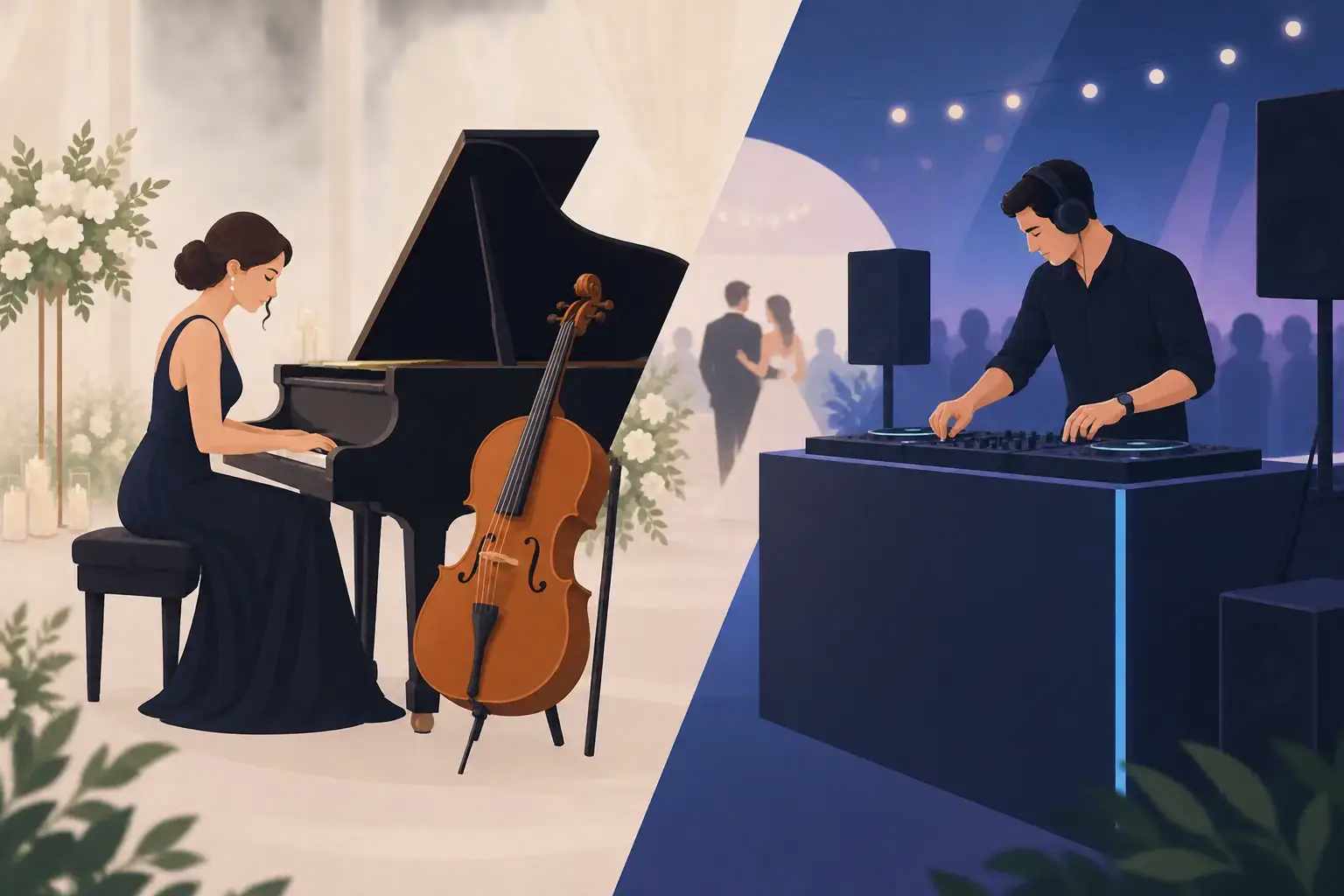
The moment the first guests arrive often shapes the mood of an occasion more subtly than any decoration. Pianist or DJ? At weddings, drinks receptions and corporate celebrations, this is more than a matter of taste. It determines whether a room feels festive, relaxed, personal or ready for dancing. The right choice therefore depends less on trends than on the schedule, the venue and the feeling you want your guests to remember.
Pianist or DJ: two ways to create atmosphere
A pianist makes music an immediate part of the moment. Every melody is created live, with subtle nuances of tempo, volume and expression. The piano can lend dignity to an entrance, accompany conversations at a drinks reception with style or give a private celebration a warm elegance that no playlist can replace. In places with character, such as a villa, a vineyard, a hotel or a historic church, the sound of an acoustic instrument blends naturally with the setting.
A DJ brings a different emphasis. With a wide selection of original recordings, a DJ can connect musical decades and create a dynamic transition from dinner to the dance floor. If the evening is meant to become energetic after the meal and your guests want to dance until late, a DJ is often the natural choice. Beat, familiarity and a continuous musical flow then take centre stage.
Both can be first-class. What matters is the role music should play at your event: should it move people and elevate a moment? Should it allow conversation without feeling anonymous in the background? Or should it open the dance floor and set the evening in motion?
When a pianist is the stronger choice
Live music has a special effect at a wedding ceremony. As the first notes sound for the entrance, the pianist responds to what is actually happening: the couple’s pace, a slight delay or the length of an emotional moment. A piece is not simply played back; it becomes the personal setting for a ceremony. The same applies to a secular wedding ceremony, blessings, christenings and farewell services, where restraint and expression are equally important.
A pianist also offers presence without intrusion at a drinks reception. Familiar pop melodies, jazz standards, film music and classical works acquire a refined, pared-back sound on the piano. Guests often recognise their favourite pieces only after a few bars: a lovely conversation starter that does not interrupt the conversation. For hosts who want to show style without creating a stiff atmosphere, this is a compelling middle ground.
A piano and cello duo takes this effect further. The piano provides harmony and rhythmic clarity, while the cello gives the music depth, warmth and an almost vocal expressiveness. From Bach to Coldplay, from bossa nova to film music, the repertoire feels festive without becoming distant. For a wedding or an exclusive reception, this ensemble is often more than background music: it becomes an experience that defines the occasion’s style.
The strengths of music performed live
Live music is particularly suitable when an occasion thrives on intimacy, aesthetics and individual moments. It offers musical flexibility, a visible artistic presence and a sound that adapts to the room. A professional musician knows when to let a piece breathe, when a discreet transition is needed and when silence is more powerful than another song.
There is also the opportunity for personal requests. Perhaps a song reminds you of how you met, a particular film melody should accompany the exchange of rings or you would like an elegant jazz programme for the reception. In a carefully arranged live version, this becomes a musical part of your story rather than a random track on a playlist.
When a DJ fits the programme better
A DJ is an excellent choice when the party is the focus. At birthdays, large weddings with dancing later on or corporate events with a lively evening atmosphere, an experienced DJ can read the room’s energy and change the programme spontaneously. From disco and funk to current pop, house, rock or Latin, the possibilities are almost limitless.
A DJ can also build musical bridges between generations. A good mix considers more than personal favourites: it takes account of the evening’s progression. Too much energy too early can overwhelm guests, while quiet music for too long can drain a celebration’s momentum. The art lies in filling the dance floor gradually.
A DJ does, however, need a setting that suits this form of music. The sound system, equipment space, volume restrictions and proximity to dining tables should be clarified early. In a small restaurant with a seated dinner, a DJ set can become more dominant than intended. In an event venue with a dance floor and a late-night programme, it may be precisely what keeps guests talking about the evening long afterwards.
The smartest solution: plan music around the time of day
The decision does not have to be pianist or DJ. Many successful weddings and events deliberately combine both formats. Live music accompanies the emotional and formal parts of the day, while a DJ takes over for the party later. Each stage gets the sound it deserves.
For a wedding, this could mean piano or a piano and cello duo for the ceremony, discreet live music at the drinks reception and dinner, followed by a DJ for the party. At a corporate event, a stylish instrumental programme suits the reception, with a DJ opening the social part only after the speeches or gala dinner. This division feels considered rather than excessive, provided handovers, equipment and timing are professionally coordinated.
If you want to book just one musical act, prioritise the occasion’s most important moment. If it is the ceremony, a reception for clients or a festive dinner, live music usually offers greater emotional and visual value. If everything revolves around a long night of partying, a DJ is generally the more suitable choice.
What to look for when booking
Quality depends not just on the musical format, but on experience with events. Professional musicians and DJs understand tight schedules, respond calmly to changes and tailor their volume, repertoire and presentation to the occasion. Ask not only for a song list, but how the music will fit into the day’s programme.
With live music, it is worth looking at stylistic range. A versatile ensemble can accompany a classical ceremony as convincingly as a modern drinks reception with pop, jazz and chillout. SwissDuo PianoCello combines the elegance of first-class classical training with bespoke arrangements of familiar melodies: an advantage when you want a celebration that feels personal without becoming musically generic.
Clarify the practical conditions too. An acoustic piano or a high-quality digital piano needs a suitable position, protection from the weather at outdoor events and, where necessary, a power source. A DJ also needs enough floor space for equipment and clear agreements on sound. The earlier these details are settled, the more relaxed the planning remains.
Ultimately, music can do more than entertain your guests: it can make the character of your occasion audible. Choose the option that lets you imagine the first note sounding exactly right when it matters, rather than simply choosing the loudest or most convenient solution.