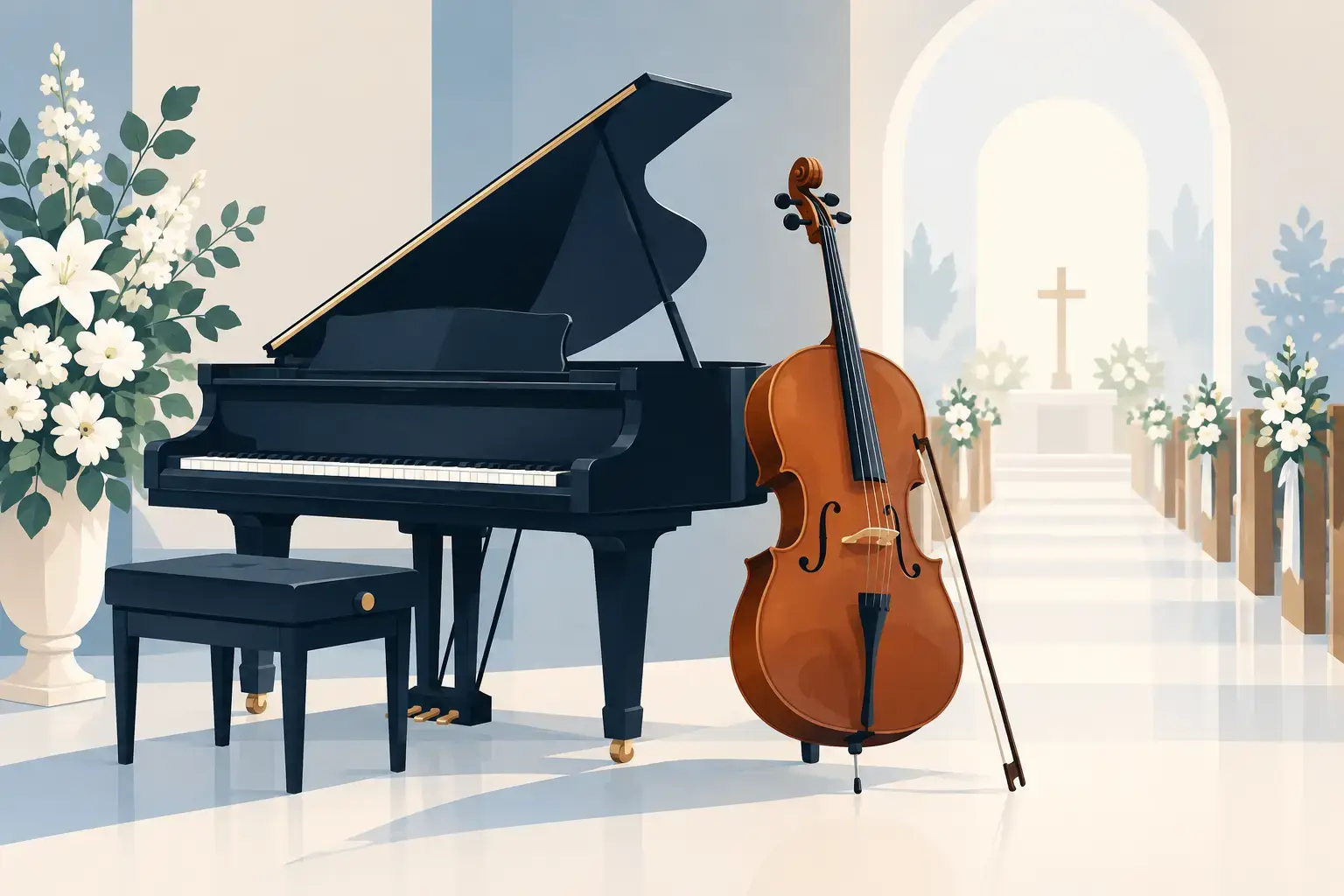
A great moment often begins not with words, but with the first few bars of music. Anyone wondering how to choose processional music should therefore look beyond a beautiful favourite piece. What matters is what the music evokes in the room: anticipation, calm, ceremonial tension or a deeply personal connection. Whether for a church wedding, a secular ceremony, a christening, a farewell or a gala, the right processional music gives the journey towards the central moment its own distinctive setting.
Processional music is more than an entrance song
A procession is movement with meaning. People enter, take their places or accompany a couple, a child, a family or a special guest. The music carries that movement and makes its significance felt. It offers a sense of direction without demanding attention and gives the occasion the dignity that a special transition deserves.
This distinguishes processional music from general background music. While a drinks reception thrives on lightness, conversation and changing moods, an entrance needs a clear musical arc. The first note should open up the room. The tempo must suit the actual walking pace. And the ending should embrace the moment when everyone has arrived.
At emotional ceremonies in particular, it is worth considering the musical choice early. A piece can sound wonderful on a playlist yet be unsuitable for a long central aisle, a small chapel or an entrance involving several people. Performed live, however, music can breathe, be extended, become more concentrated and adapt precisely to the proceedings.
What mood should the entrance convey?
The most important question is not which piece is currently popular, but what atmosphere you want to create. Should the entrance feel grand and classical, tender and intimate, modern and radiant or deliberately simple? A ceremonial Baroque work conveys structure and timeless elegance. An expressive film melody can create a deeply personal, cinematic moment. A discreetly arranged pop song combines familiarity with stylish refinement.
The music can reflect your personality. A couple drawn to classical sounds will often find exactly the right tone in a familiar work for piano and cello. Someone planning a secular ceremony in a garden might choose a gentle ballad, bossa nova or an acoustic version of a modern piece. Stylish does not necessarily mean traditional. Style comes from an authentic fit with the occasion, the setting and the people.
How do you choose processional music to fit the ceremony?
A successful piece must work practically as well as emotionally. The duration of the entrance, the number of people entering and the layout of the venue determine which music is ideal.
Plan length and tempo realistically
An entrance rarely lasts exactly as long as a song recording. In a church with a long central aisle, the walk may take two to four minutes; at a small secular wedding ceremony, often considerably less. If guests, witnesses or family members enter first, each stage needs its own musical character or at least a coherent transition.
A moderate tempo is usually the best choice. Music that is too slow can make an entrance seem heavy and hesitant. Too fast a tempo creates unintended restlessness. Pieces with a clear pulse, a sustained melody and enough space between phrases are particularly effective. Professional musicians follow the actual walking pace and can shape repeats or transitions organically.
Consider the moment after the entrance too. When the couple reaches the front, a child is carried forward for a christening or a family takes its place at a funeral, the music should not stop abruptly. A gentle fade or a deliberately shaped ending creates calm and allows the moment to linger.
Consider the space, acoustics and ensemble together
A historic church calls for a different sound from a modern event venue, a private garden or a hotel ballroom. In a resonant room, cello and piano develop a warm, distinguished depth. In a small chapel, a chamber duo can already feel remarkably present. Outdoors, by contrast, the ensemble needs to remain clearly audible despite ambient noise and changing weather.
Piano and cello combine elegance with emotional warmth. The piano provides harmony, rhythm and brilliance, while the cello gives the melody a deeply moving voice with a human closeness. For larger rooms or particularly festive entrances, a trio or quartet can create an added sense of spaciousness. More musicians do not automatically mean greater impact, however. At a small, intimate ceremony, a finely balanced duo is often the stronger choice.
The available facilities also count. Is there a well-maintained piano on site? Is a portable instrument needed? Is there a sheltered position for the musicians? These questions belong in the musical planning because they help determine both sound quality and the smooth running of the event.
Classical music, pop or film music?
Many hosts feel they must choose between tradition and personal taste. In reality, these worlds need not exclude each other. A high-quality arrangement can give a modern song the same elegance as a classical work without losing its recognisable character.
Classical processional music is particularly suitable for a sacred, formal or traditional setting. It feels dignified, clear and timeless. Pop and rock songs in chamber arrangements are excellent when a ceremony should sound more personal, contemporary or surprising. Film music often has a powerful emotional imagery and can work beautifully at secular wedding ceremonies or gala entrances.
The quality of the arrangement matters. Not every familiar melody works without vocals or a band. A good arrangement preserves a song’s essence while translating it into the language of the chosen ensemble. Piano and cello in particular need musical lines that do justice to both instruments rather than sounding like a mere copy of the original recording.
A song’s lyrics remain present
Even when a piece is performed instrumentally, many guests know the lyrics. This can be beautiful when the message suits the ceremony. It can also be unsettling if a romantic-sounding song is actually about separation, loss or a difficult relationship. With familiar pop songs, listen beyond melody and atmosphere and consider the story behind them.
This applies especially at a funeral. Music can offer comfort, awaken memories and honour someone’s personality. It should never force a mood, however. Some families want a quiet classical work; others deliberately choose a song that captures their loved one’s character. Both can be right when chosen sincerely and performed sensitively.
Give the ceremony a musical thread
The strongest effect comes when the entrance, central moments and recessional relate to one another. This does not mean everything should sound the same. On the contrary: the entrance can begin with anticipation, the signing or blessing can be quieter and more focused, and the recessional can radiate joy, relief and a sense of a new beginning.
Choose a few pieces with clear roles rather than a long collection of favourites unrelated to the proceedings. For a wedding, this might mean a distinctive entrance, understated accompaniment during a symbolic act and an energetic recessional. At a corporate event, processional music can mark the official opening of an awards ceremony before moving into elegant reception music.
A recurring musical motif can further refine the flow. Perhaps the entrance melody returns later in a quieter variation. Not every guest will consciously notice these details, but they give an occasion an exceptionally coherent character.
With live music, planning becomes a moment
No ceremony runs precisely to the second. Guests take longer, a child stops, a dress needs a little more time on the steps or an emotional moment must not be rushed. This is exactly where professional live music shows its special strength: it responds to the room and the people.
An experienced ensemble follows the proceedings, extends a passage, shapes a clear ending or lets the cello enter the melody exactly when the entrance reaches its greatest impact. At SwissDuo PianoCello, this combination of first-class playing, sensitivity and individually tailored repertoire lies at the heart of stylish musical accompaniment.
Discuss the location, ceremony programme, desired pieces and your personal ideas with the musicians early. You do not need musical terminology. Instead, describe images and feelings: festive, warm, intimate, cinematic, joyful or deeply moving. From this, a programme can be shaped that does more than sound beautiful: it supports your occasion.
Ultimately, the right processional music is the music that stills the room, lets the steps find their way naturally and makes that first look at the destination say more than any announcement.