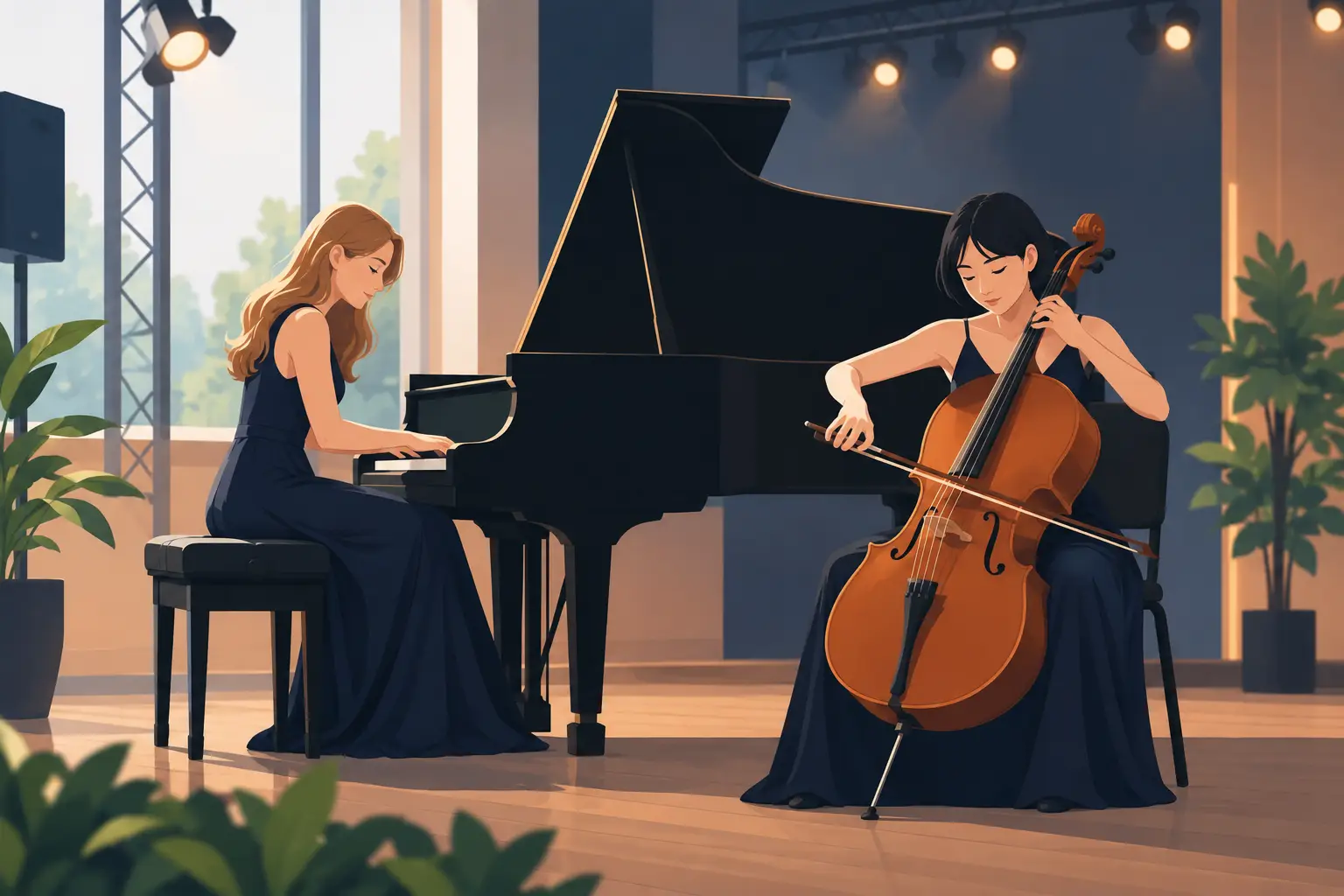
A grand piano blocking a passageway, a cello beside a noisy service door, or guests walking past throughout the ceremony: details like these can determine whether music moves people or gets lost. Preparing an event venue for live music means much more than setting aside an empty corner. Sound, sightlines, timing and atmosphere need to work together so that your occasion can have its full effect.
At weddings, elegant cocktail receptions, corporate gatherings and private celebrations, a professional ensemble gives the occasion a distinctive character. To bring out the best in piano and cello, or a larger ensemble, the venue needs to accommodate the musicians’ practical needs. Usually, a few arrangements made early are enough.
Decide what role the music will play
Before choosing a position, establish the purpose of the live music. Will it accompany an entrance during a ceremony? Create an elegant, unobtrusive atmosphere at a reception? Or become the focus of the evening during a short concert?
For a wedding ceremony, the ensemble should be easy to see and hear without blocking the view of the couple. At a cocktail reception, the music can be present without competing with conversation. A gala or dinner featuring a performance benefits from a clearly defined performance area that forms part of the room layout.
This decision also helps determine the right ensemble. Piano and cello can feel especially intimate in a villa, an elegant room or a historic venue. In a spacious courtyard, ballroom or setting with many guests, a trio or quartet may provide the musical and visual presence you want. A larger space does not always need more volume; sometimes it calls for a different musical balance.
Choose the right position for live music
The best position is rarely simply wherever space happens to remain. Musicians need a quiet, safe area away from busy routes, the buffet, bar and cloakroom. A spot beside the entrance may work for an informal welcome but is usually less suitable during an intimate ceremony. Constant movement distracts from the music.
Consider sightlines too. During a featured performance, guests should be able to see the ensemble without twisting around or standing up. For background music, a position slightly to one side is often ideal: visible enough to contribute to the atmosphere while allowing conversation to flow naturally.
A tall window, fireplace, covered arcade or airy garden pavilion can provide a beautiful setting. However, even the most attractive backdrop is unsuitable if sunlight, wind or noise interferes with the performance. Appearance and practical conditions must work together.
Allow enough space and safe access
A piano and cello duo needs room for instruments, music stands, seating and freedom of movement. Depending on the setup, allow space for cables, power connections and sound equipment as well. Plan generously so that guests and service staff cannot accidentally bump into instruments or bows.
The route to the performance area matters just as much. Discuss stairs, narrow doorways, gravel paths and long distances from parking in advance. A piano cannot simply be moved at the last minute like a decorative object. If the venue provides an instrument, check that it is playable, tuned and in good condition. Otherwise, a quality digital piano or a professionally arranged hire instrument may be more reliable.
Work with the acoustics, not just the volume
Good sound depends on more than the musicians. High ceilings, glass walls, stone floors and empty rooms can create a long reverberation that makes conversation tiring. Rugs, curtains, upholstered furniture and occupied tables change the acoustics considerably. A room that sounds hollow during a viewing can sound very different with 80 guests inside.
An acoustic check is particularly useful when music is a central part of the programme. Ask the venue about previous concerts, microphones and available sound equipment. An acoustic duo may need no amplification in a suitable room. In a large hall or on a terrace with background noise, discreet amplification can help; speeches to a large audience may also need a microphone.
Balance is essential. Live music should enrich the room without dominating every conversation. During a reception, the ensemble can adjust its dynamics subtly. For an opening, a wedding entrance or a concert interlude, the focus can shift deliberately towards the music. During a speech, the music will generally pause so that every word can be heard clearly. These transitions work best when the organisers, venue team and musicians share the running order.
Do not overlook sources of noise
Air conditioning, coffee machines, refrigeration units, glass polishing behind the bar and noisy doors are often noticed only on the day. Check whether distracting equipment can be switched off briefly during the ceremony or a featured performance. Other events nearby, building work, road traffic and church bells also deserve consideration.
Outdoor events need a backup plan. Wind can disturb sheet music and delicate musical textures, while direct sunlight is uncomfortable for musicians and harmful to instruments. Agree on a dry, covered, sheltered alternative in advance and have it ready in time. A pavilion can work beautifully if its floor, lighting and access are suitable.
Plan power, lighting and protection for the instruments
Even an acoustic performance may need electricity for a digital piano, a small sound system or a music stand light at an evening event. A working power socket should be close to the performance area. Long cables across walkways are neither elegant nor safe. Any necessary cables should be professionally secured.
Lighting deserves particular attention. Warm, well-directed light creates an attractive setting and allows musicians to read their scores. Strong backlighting from a window or a single glaring spotlight can make things difficult. For an outdoor ceremony, consider sunset: a space that is bright during setup may be too dark when the music begins.
Instruments are sensitive to moisture, sudden temperature changes and direct sunlight. A cello should not sit beside an outdoor heater, a piano should not stand in a draught, and sound equipment should not be placed beneath a leaking tent roof. These precautions protect valuable instruments and preserve sound quality.
Coordinate the schedule and communication early
Even beautiful music loses its effect if it competes with a welcome speech, clattering dishes or late arrivals. Prepare a simple schedule covering arrival and setup, any soundcheck, each music set, breaks and the precise cues for special pieces.
At a wedding, these may include the entrance, signing, a ritual and the couple’s exit. At a corporate event, they might be the arrival of important guests, the opening remarks or an awards presentation. Share these cues with the service team and host. When everyone knows when a musical moment is coming, they can give it the space it needs.
Agree on one contact person at the venue who can make decisions on the day, arrange access and respond to questions about electricity, weather or timing. Professional ensembles such as SwissDuo bring extensive event experience; hosts and coordinators contribute their knowledge of the venue. Working together keeps the occasion relaxed.
Complete the atmosphere with care
Live music is part of the presentation of your event. A tidy performance area, suitable chairs, an attractive backdrop and understated decoration give it the setting it deserves. Keep advertising boards, drinks crates and distracting equipment away from the ensemble. Small design choices can make a striking difference.
When the space, schedule and music are in harmony, guests may not notice each organisational detail. Instead, they feel the ease of the reception, the emotion of the ceremony and the elegance of the evening. That is why it is worth preparing your venue early with live music in mind: a beautiful occasion can become a memory that stays with everyone.