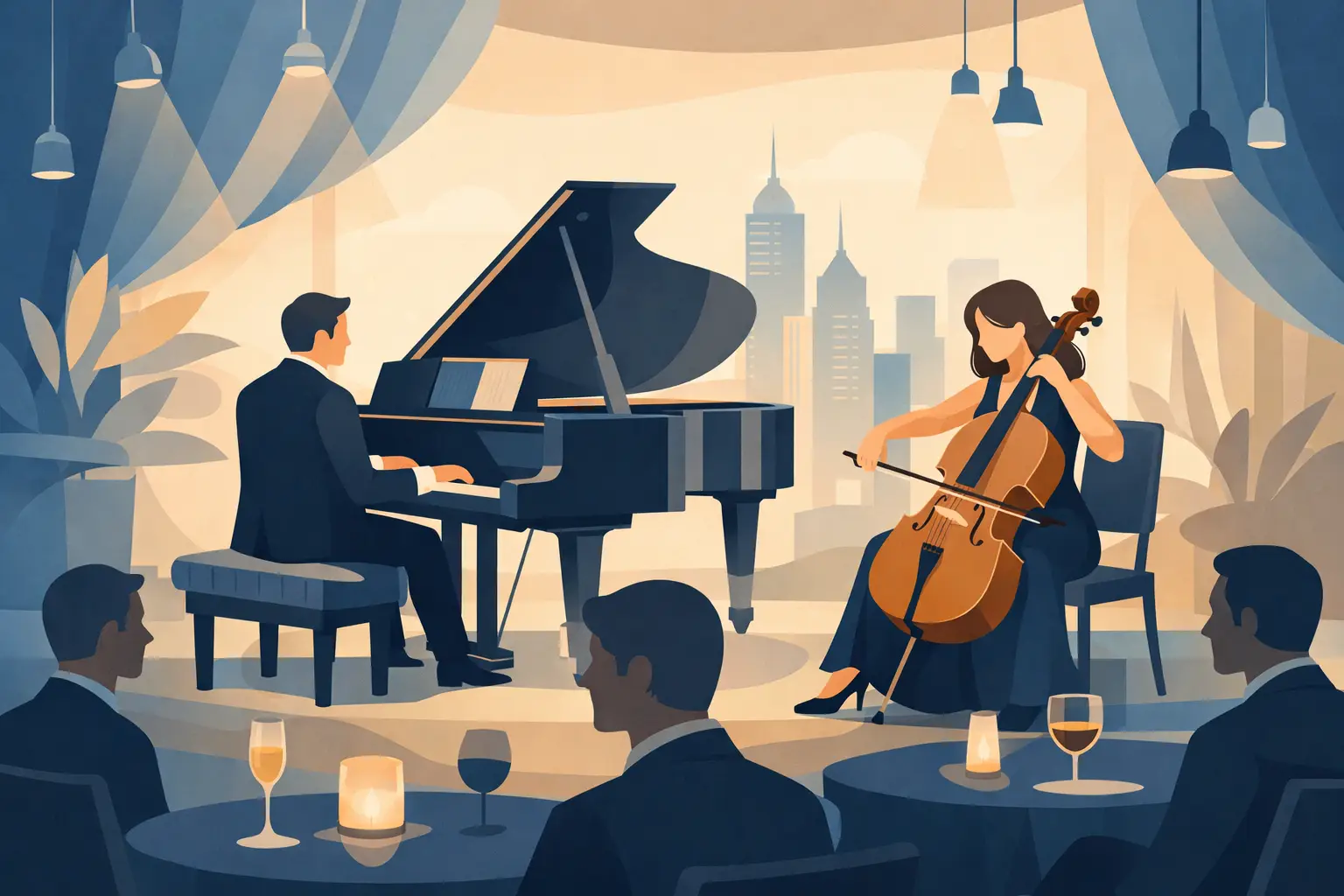
When the first guests arrive at the reception, it is often decided in a few minutes whether an event only seems professionally organized or whether it is developing its own charisma. A guide for business event music therefore does not begin with the question of your favorite song. He starts with the atmosphere that your company wants to convey: confident, warm, international, festive or deliberately relaxed.
Live music can refine a room, facilitate encounters and give a company event that personal touch that will be remembered for a long time. In order for this to succeed, music, process, space and audience must fit together. Especially in the upscale business environment, less is not automatically more – but music should never be in the foreground when discussions and relationships are the focus.
Why business event music is part of your performance
A company anniversary, a customer event or an exclusive aperitif is always an expression of the brand. Architecture, light, catering and greeting tell a story together. The musical accompaniment is not a decorative addition. It influences how guests perceive the event emotionally.
For example, a stringed instrument and piano create a warm, cultivated presence without disturbing the culture of conversation. Well-known melodies from pop, film or jazz are given a new, elegant color in a high-quality arrangement. This is accessible without being arbitrary. For many companies, exactly this connection is crucial: classic class with a repertoire that appeals to different generations.
The right music also supports the rhythm of the evening. It welcomes guests, accompanies the transition from the aperitif to dinner and can effectively frame a program item. An act that is too loud or stylistically inappropriate, on the other hand, distracts, makes conversations more difficult and can leave a restless impression even with perfect organization.
Business event music guide: Read the occasion right
Before you choose a cast or style, it is worth taking a closer look at the character of your event. Not every occasion needs a concert program. Not every reception benefits from pure background music. The best choice is the interaction of goal, guests and dramaturgy.
Reception and aperitif: presence without conversation noise
During a standing reception, music should enliven the room and at the same time leave enough space for discussions. Acoustic formations prove themselves particularly well here. A piano cello duo can create a stylish sound world with Bossa Nova, jazz standards, selected pop songs, film music and classical works that will never appear in a sleek manner.
The volume is important. In rooms with hard surfaces such as glass, stone or high ceilings, music wears more than you would expect to see. Professional musicians take this into account in their playing style and carefully adjust the technical reinforcement. For a small aperitif with 40 guests you need different dimensions than for a reception with 300 people in an event hall.
Gala, anniversary and dinner: set musical accents
Live music can become more visible at a gala evening. A festive start to greet you, a musical moment before the speech or a performance between the courses gives the evening structure. Such accents work particularly well when precisely matched with moderation, light and service.
Here a trio or quartet can have the greater effect. More instruments create depth of sound and a representative stage without necessarily creating a loud show. Whether a short concert set makes sense depends on how attentive the guests can be at this point. During a main course, reserved accompaniment is usually more harmonious than a demanding concert piece.
Product launch and customer event: Make brand audible
A clear moment is often the focus of a launch: the countdown, the first look at a product, the stage or the speech of the management. Music can condense this moment. You don’t need a dramatic over-production for this, but an arrangement that fits the brand world.
A technology company can work with modern, clear pop or film music arrangements. A traditional brand may choose classic works with contemporary lightness. Those who expect international guests are often well advised with well-known melodies, because they create a connection across language borders. It is important that the music does not act like a foreign body, but absorbs the imagery and attitude of the company.
Choose the right cast
The cast determines not only the sound, but also the visual effect. A duo of piano and cello looks elegant, approachable and flexible. It is suitable for aperitifs, smaller dinners, vernissages, customer events and ceremonies. The instruments are present, but not dominant – a great advantage if the guests are to remain in exchange.
A trio or quartet is recommended if the room is larger, the occasion seems more formal or the music deliberately has a representative status. Additional strings give the sound more volume and create a festive picture, especially at galas, award ceremonies or anniversaries. However, this also means: more space required, more coordination effort and a correspondingly higher budget.
A larger formation is not automatically the better choice. In an intimate location, a quartet can look too big visually and acoustically. Conversely, a duo may lose their effect in a spacious hall without sensitive sound reinforcement. Professional advice therefore takes into account room size, guest flow, existing technology and the desired importance of the music.
Repertoire: known, high quality and adapted to the moment
A good repertoire for company events creates recognition without slipping into any arbitrariness. Guests often respond particularly positively to melodies they know, but in an unexpectedly elegant version. A pop classic for cello and piano can work just as well as a jazz standard, a film melody or a sentence from the classic repertoire.
Light, inviting pieces are suitable for the start of an event. With increasing evening mood, the program can become warmer, more rhythmic or emotional. At an award ceremony or a personal appraisal, a single, carefully selected work can have a stronger effect than a long announcement.
Caution is advised if contrasts are too strong. Very melancholic music can be inappropriate during an exuberant customer aperitif, while overly lively titles at a memorial moment lack the necessary dignity. Good event music not only follows a playlist, but what is happening in the room.
Planning: This information makes the difference
The clearer the information in advance, the more confident the musical implementation. Venue, date, number of guests, time slots and desired staffing form the basis. Equally relevant are construction times, parking facilities, electricity connections, a possible stage and the exact process of greeting, talking and eating.
A short description of the desired atmosphere is particularly helpful. Formulations such as «Elegant and Modern», «Unobtrusive during the Apéros» or «An Emotional Highlight after the Greeting» provide more orientation than a long list of individual songs. An experienced ensemble can develop a suitable musical concept from it and, if necessary, make concrete repertoire suggestions.
The acoustics also deserve attention. Background music should not have to play against a loud bar, an open buffet or ongoing conversations. If possible, the music is placed to define the reception area without blocking walkways. When talking, it should be clear whether the musicians are taking a break, ending quietly or making a transition.
What distinguishes premium live music
In the business context, reliability is part of artistic quality. Punctual appearance, well-groomed appearance, careful communication and a respectful treatment of everyone involved are just as crucial as musical virtuosity. Guests take this for granted, even if they do not expressly name them.
First-class musicians don’t just play a fixed program. You read the room. If guests arrive later, the reception can be extended. If a speech takes more time, it takes a flexible reaction. If a musical wish really suits the occasion, it should be able to be integrated in style. At Swissduo Pianocello, this combination of artistic excellence and event-tested adaptability is part of the claim of every accompaniment.
The price should therefore not only be measured by the playing time. It includes preparation, individual coordination, arrival, professional equipment, repertoire work and the certainty that an important occasion will be played musically. For a representative event, this is an investment in the overall impact – and thus in the memory of your guests.
Do not select Live Music as the last item on the checklist. If she is involved in the planning early on, she can combine the first reception, the important words and the last moment of conversation with exactly the elegance that does justice to a special company event.