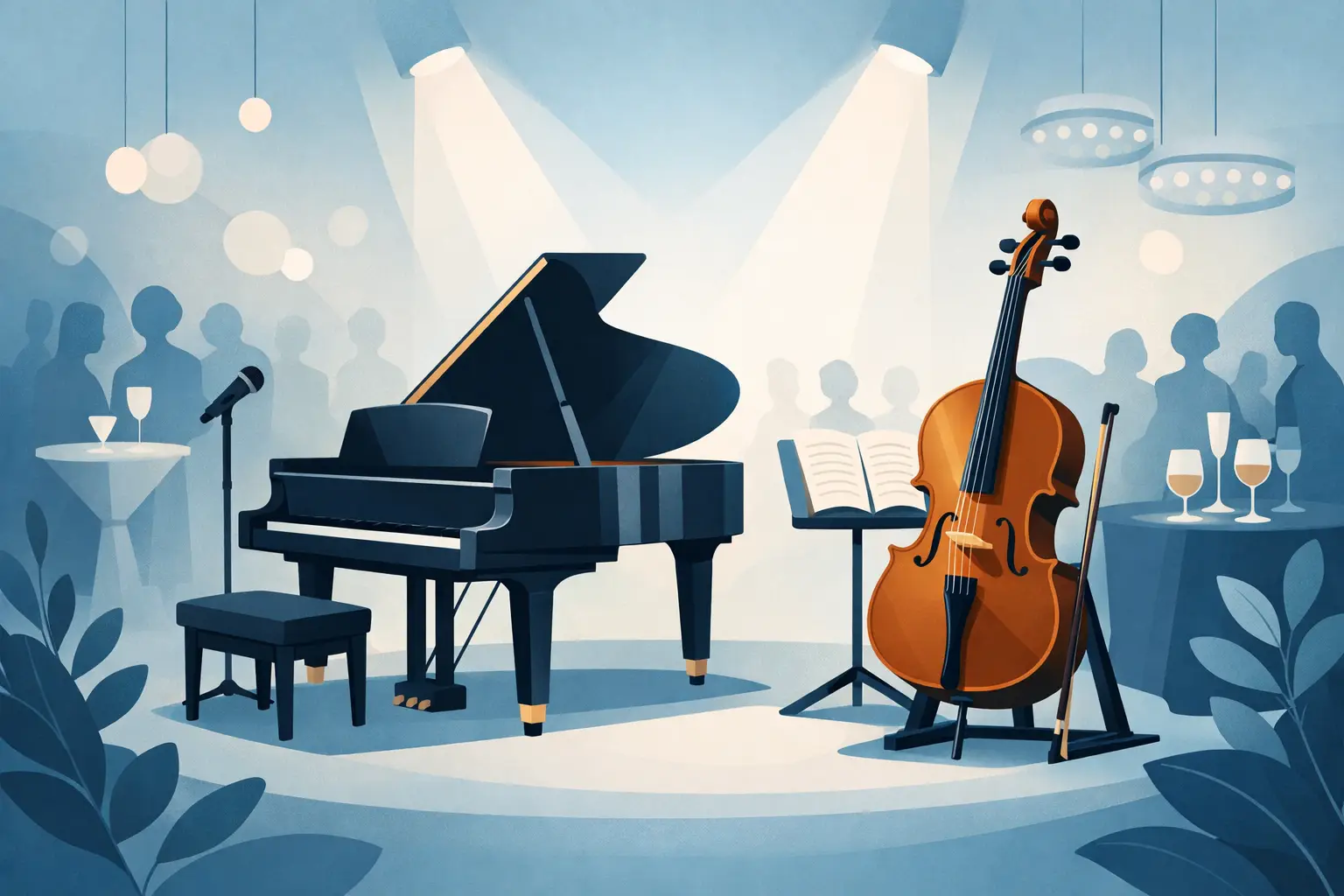
Anyone who plans exclusive occasions quickly realizes that the music is not simply a program item. It shapes the first impression, directs the mood in the room and often decides whether an event looks elegant or just well organized. This is exactly where this guide comes on for exclusive event music – for hosts and hosts who are not looking for any musical accompaniment, but a stylish setting with an effect.
Whether it’s a wedding by the lake, customer reception in Zurich, a private celebration in a villa or a festive ceremony in a small circle: high-quality live music creates an atmosphere without imperving yourself. It connects people, refines rooms and gives special moments that depth that rarely arises with a playlist. However, the decisive factor is not only that music is played, but how precisely it is tailored to the occasion, the audience and the course of the day.
What exclusive event music really makes
Exclusive event music does not automatically mean loud, big or spectacular. In the premium sector, it’s more about level, presence and sensitivity. The musical quality must be at the highest level, but the ability to read an event is just as important. A reception requires different nuances than a secular wedding ceremony. A gala dinner needs a different energy than an aperitif in the garden.
This is exactly the difference between ordinary entertainment and a musical concept with class. A first-class ensemble not only brings technical skills with it, but also depth of repertoire, stylistic security and a sure feeling for timing. The music should wear the occasion, not cover it up. It should trigger emotion without being artificial.
The optics also play a role. Exclusive event music is always a combination of sound, appearance and effect in the room. Cast, clothing, stage presence and instruments convey unconscious value. Especially at upscale private celebrations or representative corporate events, this is not a secondary topic, but part of the overall experience.
Guide to exclusive event music: Read the occasion first
Before music styles or favorite songs are discussed, a simpler question is worthwhile: What mood should your event have? Many wrong decisions are made because titles are discussed too early and too little about the effect.
A wedding thrives on compression. Every musical commitment gets weight because people listen, wait, feel. Music is allowed to lead emotionally here. An aperitif works differently. It’s about lightness, movement and a Elegant background atmospherethat supports conversations. On a company event, on the other hand, representation often counts. The music should convey style and sovereignty and match the brand or the host.
Those who clearly state the character of the event make better musical decisions. Should it be romantic and fine? Modern and high quality? Solemn with a classic touch or consciously across genres with well-known melodies in a noble arrangement? This direction later determines the appropriate cast, the repertoire and the volume.
The right cast for the right moment
Not every formation suits every occasion. Especially in the exclusive segment, Kleiner is often more effective. A Piano and cello duo Elegance, warmth and versatility combines. It looks cultivated, remains flexible and fits into sacred rooms as well as in hotels, gardens or modern event locations.
For intimate ceremonies, a smaller cast can even touch more than a larger ensemble. The music seems more personal, closer and often finer in gradation. In the case of larger receptions or galas, a trio or quartet, on the other hand, can bring more sonic fullness and carry the space more naturally.
So it doesn’t depend on as many musicians as possible, but on the right relationship between the room, the number of guests and the occasion. Too large a setup can quickly make a dominant effect on a small scale. An ensemble that is too small, on the other hand, gets lost in a spacious location. Exclusivity is not shown in exaggeration, but in accuracy of fit.
Repertoire with style instead of wish list without a line
Many hosts want well-known music – and that makes perfect sense. Familiar melodies create closeness, recognition and emotional resonance. The only thing that matters is how they are presented. A high-quality event does not live from a random collection of popular songs, but from a musical line.
Classic works give ceremonies gravity and beauty. Pop ballads in stylish arrangements create modern emotionality. Jazz, bossa nova or film music can give an aperitif or dinner refined lightness. The combination of classic excellence and carefully chosen crossover elements in particular is particularly contemporary today.
A repertoire that wants to serve all tastes at the same time is less helpful. If an energetic rock song is followed immediately by a romantic classic, the mood can change. A good musical arc is created by transitions, colors and feelings of tension. The audience often perceives this coherence more than you think.
How live music refines the process
Exclusive event music unfolds its full effect when it is thought dramaturgically. That means: not just book a time window, but also consciously set musical moments. This creates a much rounder experience, especially at weddings, receptions and private celebrations.
At a ceremony, the entry, ring exchange, silent transitions and the recessional are often the strongest emotional points. The aperitif is then about a gentle change – away from concentration to openness and conversation. Music can accompany this transition elegantly, without breaking. At a dinner, on the other hand, subtle, stylish accompaniment often looks more noble than a full concert character.
This is also worth taking a look at company events. The guests arrive, orient themselves, make contacts. Later, speeches, networking or a food that has been placed will follow. Anyone who plans music to match these phases does not create an acoustic backdrop, but an atmosphere with a guide. That looks professional and generous.
Guide to exclusive event music when planning
The higher quality an event, the more important the details behind the scenes are. An excellent musical result begins long before the first note. This includes the correct placement of the musicians, clarity about electricity, weather, acoustics and time windows as well as a realistic assessment of the spatial conditions.
In a church or a hall with a lot of reverberation, you need different musical decisions than in a modern event hall or on a terrace. Wind, temperature and instrument protection are added outdoors. The distance to the guests also plays a role. Music should be present, but not disturb. This balance is particularly central to aperitifs and business events.
Coordinating with the process is just as important. When program items shift, the musical accompaniment should be able to react flexibly. A professional ensemble thinks along, stays confident and can also spontaneously respond to changed situations. This security is often more valuable for exclusive events than a big show.
How to recognize real quality
For non-musicians, it is not always easy to judge quality at first sight. A good clue is versatility without arbitrariness. Anyone who can interpret classical works, pop, jazz or film music in a convincing and stylish manner usually not only brings craftsmanship with them, but also musical maturity.
Also pay attention to the effect in the picture and appearance. Does the ensemble look well-groomed, safe and representative? Is the performance emotional but never intrusive? Is there a noticeable understanding of events – i.e. for timing, atmosphere and dealing with different guests? Exclusive event music needs both: artistic class and event-related professionalism.
Communication is also a quality feature. Anyone who advises precisely, makes suitable suggestions and does not simply sell standard packages understands the occasion in its specialty. Exactly this individual curation makes the difference between a beautiful performance and an unforgettable setting in the end.
If exclusivity is to become personal
The most beautiful musical moments often arise where elegance and personality come together. Maybe there is a song associated with a common story. Perhaps a company event should appeal to international guests and therefore be stylistically broader. Maybe they don’t want serious ones for a funeral service, but comfort and dignity.
Exclusivity does not mean distance. It means that music is individually designed without losing class. This is exactly why tailor-made arrangements, finely tuned casts and a Curated Repertoire so valuable. They create closeness without becoming arbitrary.
An ensemble like Swissduo Pianocello shows how this balance can be achieved: with first-class musical education, a stylish presence and a repertoire that combines classic beauty with modern sound worlds. This connection is often crucial for demanding occasions in Switzerland.
If you are planning a special event, you shouldn’t just think about music at the end. She belongs in the concept from the start – as a quiet luxury that doesn’t loudly ask for attention and yet remains in my memory for a long time.