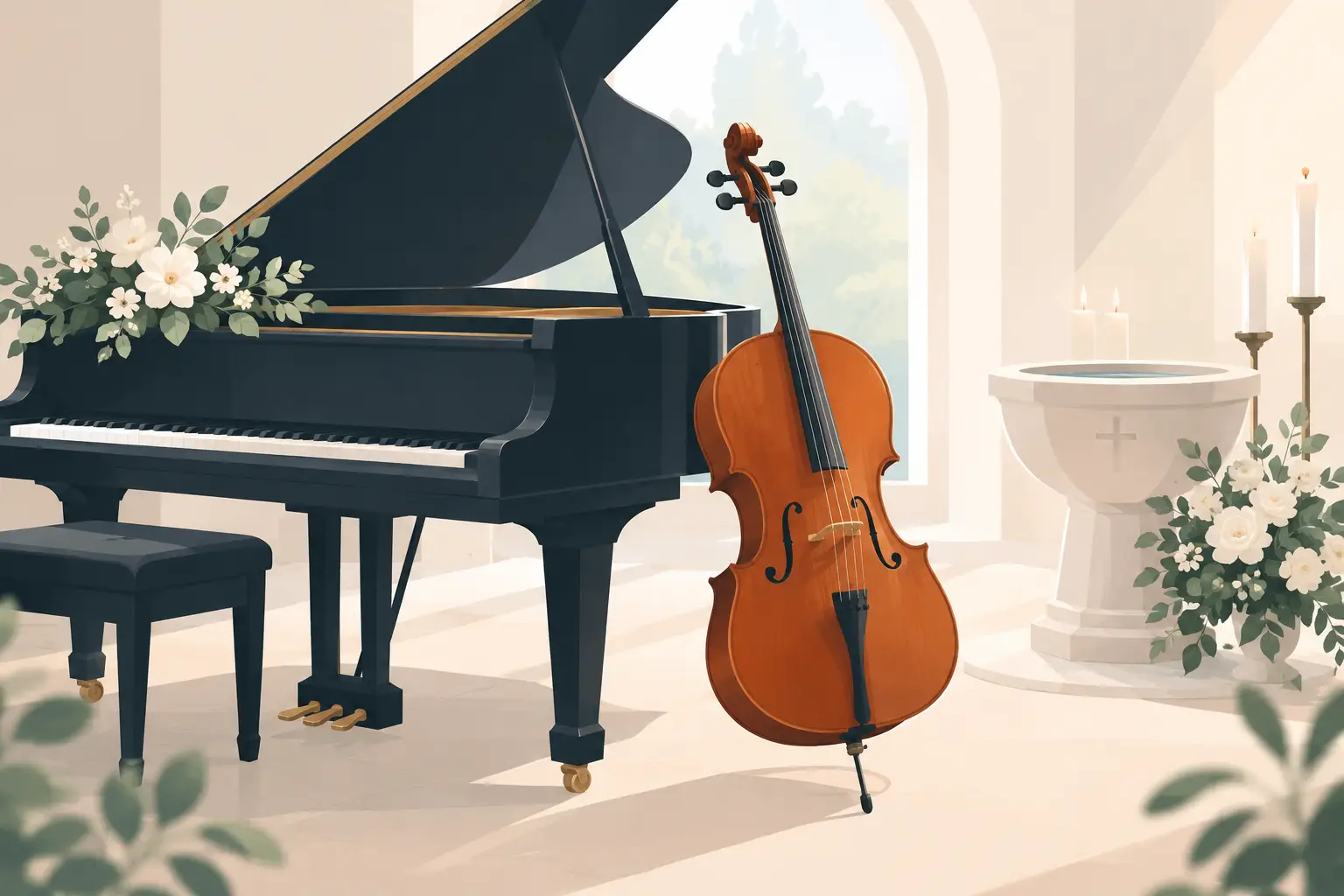
A child is welcomed into the family, candles are lit, a name is spoken — and suddenly a single cello melody reaches further than words can. Choosing cello music for a christening means shaping more than one item in the programme. Music creates the emotional setting for a moment that parents, godparents and grandparents will remember for years.
The cello is particularly beautiful at christenings because its sound is warm, human and celebratory. It can lend classical dignity to a church ceremony, while also bringing elegance to a contemporary celebration in a chapel, garden or private setting. The aim is not to fit in as many pieces as possible. What matters is that the music, venue and family’s personality come together naturally.
Choosing cello music for a christening: character comes first
Start with a simple question: how would you like this day to feel? Some families want a quiet, sacred atmosphere; others imagine a bright, contemporary and personal celebration. The cello can express either beautifully. Your choice should depend less on supposed rules than on the feeling the music creates.
For a traditional church christening, works with clear, sustained melodic lines are especially suitable. Johann Sebastian Bach, George Frideric Handel and Franz Schubert bring a ceremonial calm without making the occasion feel heavy. A carefully arranged Ave Maria can also be deeply moving, provided it suits the family’s religious tradition and personal wishes.
If you prefer a modern touch, consider familiar melodies from pop, film or musical theatre. A gentle ballad, a favourite song of the parents or a film theme can feel very intimate in an elegant cello and piano arrangement. Not every song, however, is suitable for a christening. Songs whose original lyrics centre on separation, longing or dramatic love stories take on a different colour instrumentally, but should still be chosen thoughtfully.
The most beautiful selections often combine familiarity with style: a classical piece for the entrance, a personal melody after the baptism and a bright, joyful ending for the departure. This creates a musical arc that supports the ceremony rather than overshadowing it.
Which ensemble suits the christening ceremony?
A solo cello feels focused, intimate and refined. It can be exactly right for a small chapel, a non-religious naming ceremony with close family or a venue with limited space. The cello carries a melody with great expressive power and needs no elaborate staging.
For many christenings, however, the combination of cello and piano offers a particularly balanced sound. The piano adds harmonic depth, supports the entrance and departure, and creates a fuller texture without dominating the ceremony. A professional piano and cello duo brings an elegant presence, especially in larger churches or celebrations with many guests.
A trio or quartet may be appropriate if the church is large, the christening forms part of a longer service or music is also planned for the reception afterwards. More musicians do not automatically mean greater impact. A larger ensemble can feel too prominent in a small room, yet sound wonderful in a church with a high ceiling. Acoustics, guest numbers and the desired atmosphere should therefore be considered together.
The three key musical moments
A christening does not need a concert programme. Three to five thoughtfully placed musical moments are usually enough. They give the ceremony structure, create stillness and leave it room to breathe.
The entrance and arrival
The entrance can be festive without becoming elaborate. A piece with a gentle opening and a bright, open character helps guests settle into the occasion. Melodies that unfold gradually are particularly beautiful as the family approaches the font or the place of blessing. If parents and godparents enter together, a more clearly defined pulse may help. When a small group is already gathered, a short musical prelude is often sufficient.
During or after the baptism
The pouring of water, the blessing or a personal address is often followed by a moment of special stillness. This is where the cello can have its greatest effect. A lyrical melody gives loved ones time to reflect on what has just happened. This piece can be personal: perhaps it recalls the pregnancy, a special family moment or a song that has accompanied the parents for a long time.
A realistic length is important. Two to four minutes works well in many ceremonies. If the ritual lasts longer or cannot be timed precisely, the music should allow flexibility. Professional musicians can adapt repeats, transitions and a musical ending to the moment as it unfolds.
The departure and transition to the celebration
The departure can sound noticeably more joyful. After the solemn heart of the christening, the mood opens out towards time spent together. A buoyant classical work, a familiar optimistic melody or a stylishly arranged pop song provides a warm conclusion. If an apéritif reception follows, the musical theme can continue gently, moving from ceremonial music to elegant background music.
Repertoire: familiarity is not a measure of quality
Many families begin with a list of well-known titles. That is understandable, but not always the best starting point. A world-famous work may sound majestic in a large church and overly dramatic in a small chapel. Conversely, a simple melody, sensitively arranged for cello and piano, can have an exceptionally personal effect.
Pay attention to the musical language. Flowing melodies, warm harmonies and a clear structure are usually a good fit. Highly virtuosic, loud or rhythmically dominant pieces can be impressive, but may draw attention away from the child and the symbolic ritual. Film music also deserves a closer look: some themes are moving, yet belong to a dark original story that may not suit every occasion.
Professional advice is especially valuable when parents have different wishes. One might love Bach, while the other would like a modern ballad. Instead of choosing one side, a curated programme can bring both worlds together. This is precisely the strength of high-quality live music: the piece alone is not everything. Interpretation, the musical arc and its place in the ceremony matter just as much.
Church, naming ceremony or celebration at home
The venue influences the choice of music more than many people expect. Churches often have a long reverberation. Slow pieces with clear lines gain grandeur there, while fast passages can become blurred. It is also wise to check early with the parish or person responsible which music is permitted during the liturgy and where it can be included.
A non-religious naming ceremony in a garden, hotel or private venue offers more freedom. The repertoire can be more contemporary and individual. Outdoor settings also raise practical questions: is there shade for the instruments and musicians? Is there a sheltered area in case of bad weather? Will the natural sound carry sufficiently, or will a larger gathering need discreet amplification?
A christening celebration at home can also be musically exceptional. Here, restraint is often the right approach. Solo cello or a duo with a compact digital piano creates intimacy without making the room feel like a stage. Quality is expressed not through volume, but through sensitivity to the occasion.
Planning without pressure
Discuss the music early enough for preferences, timings and practical details to come together. Useful information includes the exact venue, approximate guest numbers, the ceremony’s start time and duration, and whether music is also wanted for the reception. Feel free to suggest favourite pieces, even if they initially seem unusual. Experienced musicians will assess whether a title can be arranged appropriately and recommend elegant alternatives where needed.
Allow some breathing space in the schedule. Christenings do not always follow a minute-by-minute script, especially with young children involved. An ensemble experienced in ceremonies responds calmly to delays, extends a piece when necessary or bridges a pause with a short improvisation. That composure is an essential part of first-class musical accompaniment.
SwissDuo creates these programmes with classical excellence and a repertoire spanning Baroque music, film themes and finely arranged pop melodies. The result is not a generic playlist, but music that reflects your family’s character and serves the occasion with elegance.
Ultimately, the choice can be deeply personal. Do not choose a piece simply because you think it “has to” be played at a christening. Choose music whose sound you can imagine remembering one day as you hold your child in your arms.